Westek Electronics outlines Vitrek 964i cards for 3, 7, 10 or 15 kV requirements and multi-point test setups, supported for customers throughout Australia.
Selecting Vitrek 964i cards requires more than matching them to equipment operating voltage. The configuration must cover the applied test voltage, electrical points and whether each point needs the high-voltage bus, return bus or both. Defining these requirements before requesting a quote helps avoid an underrated path or unnecessary capacity.
Which Voltage Rating Fits the Required Test?
The correct family is the one whose verified rating covers the maximum voltage in the test procedure. We list LV3 cards at 3 kV and HV7, HV10 and HV15 families nominally at 7, 10 and 15 kV in our high-voltage switching system range.
Do not treat a family name as proof that its AC and DC limits are identical. Confirm the test type and rating of the card, multiplexer, connector, lead and fixture. Our 16-conductor cable example uses 8,500 V, above the nominal HV7 level, so it needs a higher family with its applicable rating verified.
Matching Cards to the Test-Point Arrangement
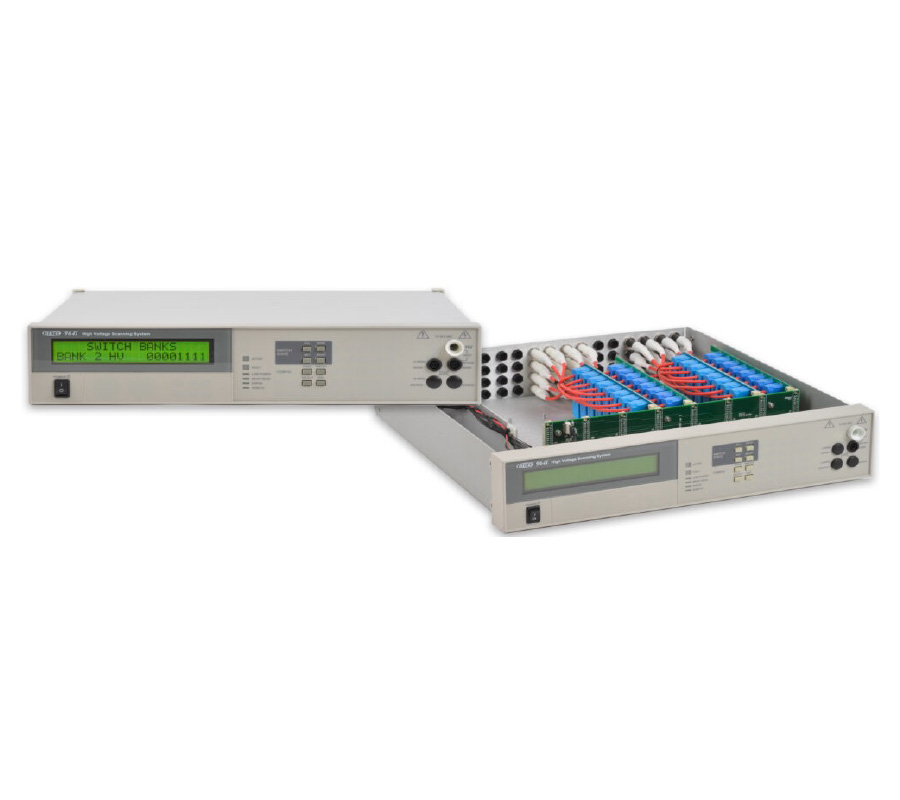
The 964i accepts up to eight eight-channel cards and supports up to 64 switching channels, with up to 60 rear-panel terminals. Usable DUT-point capacity depends on routing because a point needing both buses can require more resources than a fixed-bus point. Count electrical paths, not just connector pins.
- Single-bus routing: The -8W HV and -8R LV cards provide eight source outputs, while -8B cards provide eight return outputs.
- Split-bus routing: An -8S card provides four source and four return outputs for fixtures needing both paths.
- Dual-bus routing: Paired source and return cards support points that must switch independently to either side.
- Preconfigured capacity: Our HV7 systems use two cards for eight dual-bus points, four for 16 and six for 24.
- Card calculation: Size Vitrek 964i cards from required relay paths and add a voltage-matched MX2 multiplexer where hipot and continuity access are needed.
Details to Confirm Before Requesting a Quote
A useful request defines the complete test rather than a voltage family alone. We can then assess the mainframe, cards, multiplexer and accessories alongside a compatible Vitrek 95X Series hipot tester or supported equipment.
- Test method: State whether the sequence uses AC hipot, DC hipot, insulation resistance, continuity or another supported measurement.
- Electrical limits: Provide the maximum applied voltage and required current.
- Routing map: Count unique DUT points and identify source, return or dual-bus access.
- Existing equipment: Specify the tester, control method and other instruments requiring matrix access.
- Fixture requirements: Include connectors, leads, enclosure, interlock and expected expansion.
- Safety controls: Automated routing reduces lead changes but not high-voltage risk. Suitable grounding, guarding, procedures and competent personnel remain necessary under workplace electrical-safety duties.
Match Your Vitrek Configuration to the Test Method
A sound configuration starts with the approved test method and maps its voltage, current and routing requirements to the DUT. At Westek Electronics, we can review those inputs and identify an appropriate mainframe, cards, multiplexer and compatible accessories without overspecifying the system. This supports a clearer purchasing decision and a switching path aligned with the intended test sequence.
Request a configuration-specific quote using your test voltage, DUT-point map, required measurements and existing Vitrek equipment.